
Many people feel trapped between the life they have and the life they know they deserve. They are brave, possess huge potential, and work hard, yet they feel stuck. This isn’t a failure of effort; it’s a failure of method.
The biggest obstacle to a successful career or life change is not money or talent—it’s the lack of a Calculated System to manage risk and resources. We need a way to Recycle our past experiences and potential into assets for our next adventure.
This Collective Recalibration Toolkit provides three accessible, low-risk tools to start that process today.
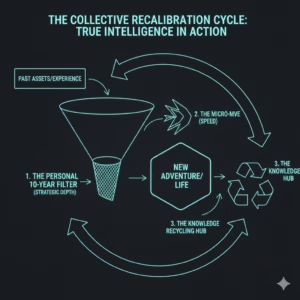
Tool 1: The Personal 10-Year Filter (Finding Your Depth)
The reason most people hesitate is fragmentation—they try to solve too many small problems at once and never define their true destination. This leads to wasted effort.
- The Challenge: You are constantly reacting to today’s demands (bills, emails, minor deadlines).
- The Tool: The 10-Year Filter. You must define your Depth by looking far ahead. Ask yourself: “What is the single, non-negotiable state of my life, health, and career ten years from now?”
- How to Apply: Once you define that clear, focused destination, every daily decision must pass this filter: “Does this action move me toward my 10-Year Goal?” If the answer is no, the task is a distraction and must be eliminated or minimized. This instantly frees up energy and aligns your small, daily Speed toward your massive vision.
Tool 2: The Micro-MVE (Minimum Viable Experiment)
The fear of change is usually rooted in the terrifying thought of committing everything to an uncertain path. The solution is to replace the “leap of faith” with a calculated, low-risk test—the Minimum Viable Experiment (MVE).
- The Challenge: You need to change careers, but you can’t afford to quit your current job.
- The Tool: The Micro-MVE. This is the smallest action you can take to test your new passion with maximum learning and minimal risk.
- Instead of: Quitting to start a business.
- Try: Committing 2 hours per week to build a single, small product or take one online course. Offer a micro-service for free or at a very low cost to get feedback.
- How to Apply: Define your Risk Window (e.g., 6 months and $100). If the test fails, you only lost 6 months and a small budget, but you gained priceless Wisdom about the new industry. This allows you to apply Speed safely.
3. Tool 3: The Knowledge Recycling Hub (Managing Your Assets)
The greatest asset you possess is not your bank account; it’s your Experience and References. Most people see their past as irrelevant baggage when they transition. We must teach the community how to Recycle this existing capital.
- The Challenge: You feel like you’re starting from scratch in a new field.
- The Tool: Knowledge Recycling. Treat every piece of your past expertise as transferable capital. Your years in Finance gave you analysis skills; your time as a teacher gave you communication skills. These are your foundational Depth assets.
- How to Apply: Share your recycled knowledge. Find one person looking to enter the field you just left, and mentor them. Simultaneously, find one person who has mastered the field you want to enter and ask them for one hour of their Wisdom. By sharing your assets, you gain the network and guidance you need for your new adventure. This activates the Resilient Resource Loop—we all benefit from the effort already spent.
Your Call to Construction
Your journey toward a better life is a model for the collective. By using these three tools, you replace paralysis with disciplined movement. You are no longer jumping blindly; you are making a Calculated Leap fueled by True Intelligence.
The time to begin your next adventure is now. Start with the 10-Year Filter and define your destination.

